

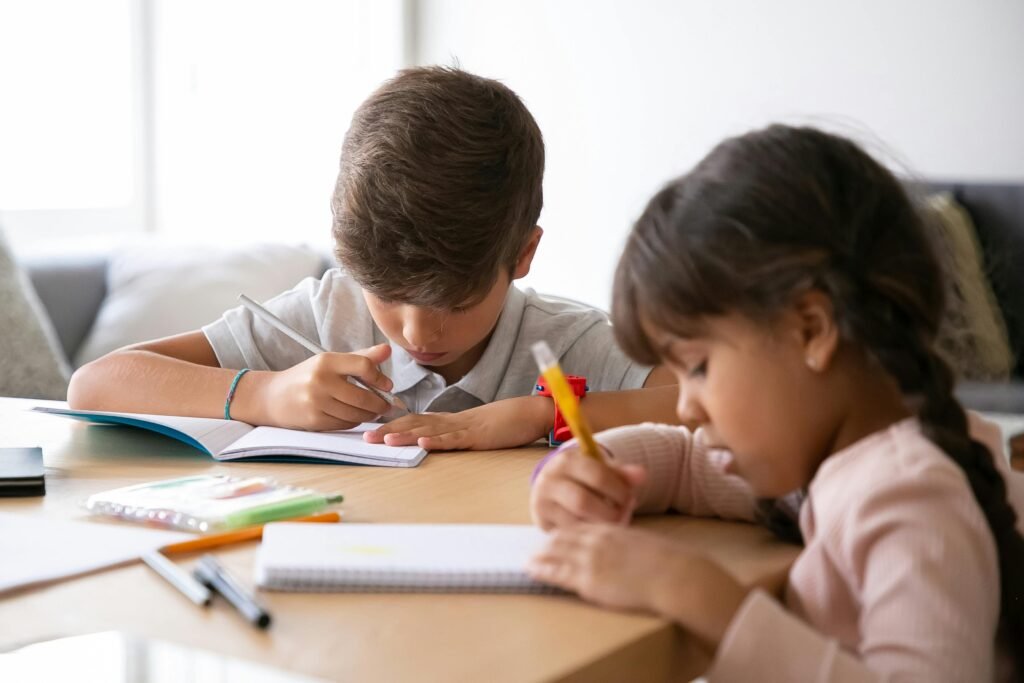
This favored “teacher hack” is a time-tested, well-researched strategy to encourage independence in children. Parents can implement it for just about anything they want to teach their kids at home from reading to social skills to chores.
Table of Contents
- The Ultimate Hack to Encourage Independence
- How To Encourage Independence At Home
- How to Encourage Independence At Home
- Why The Gradual Release of Responsibility Works
- Pros and Cons
- Conclusion
- References
One of the most staggering and disappointing things I noticed as an educator when I started in 2018 (and which increased dramatically after the COVID-19 lockdowns) was the lack of student independence in learning.
In the classroom, kids seemed less and less willing to try new things. They would constantly ask, “How do I do this? What do I do now? Can you help me?” without even having attempted anything first! Perhaps you as a parent have experienced this problem. Maybe you’re frustrated by your child’s lack of ownership in their learning or are concerned that this behavior is a sign of low self-esteem. Both are valid thoughts. I often wondered what this generation with so much learned-helplessness would look like in the future. Sometimes I just wanted to –or did – sit them all down and say, “Come on! Let’s take risks! It’s okay to be wrong as long as you take what we learned together and just try something!” But in the moments when I did actually do this, it yielded very little change.
Why? Because taking educational risk is a skill that students need to be taught, just like any other.
So what did I do about it? And what can you do at home? Let’s take a look at a research-based method of teaching that encourages independence in a child’s learning and equips them to take logical risks in their education.
The Ultimate Hack to Encourage Independence
Not so much of a hack as it is a research-based strategy, what we are talking about today is known as The Gradual Release of Responsibility (GRR). The GRR provides a structured plan for teachers to slowly release the responsibility of performing a new skill from the teacher to the students.
In this article we will take a look at what the GGR is, how you might use it at home, why it is effective (especially for children with reading difficulties), and some pros and cons.
How To Encourage Independence At Home
This method can be tricky for classroom teachers to master, and I have seen very few teachers do it well. It took me a lot of intentional planning, coaching, and practice before I got good at it. But I think it likely will come much more easily to parents because of the one-on-one setting and a parent’s deep knowledge of their child’s strengths, weaknesses, and learning preferences. (If you’ve been around here for a while, you know we call this A Parent’s Advantage.)
There are lots of different ways to slice-and-dice the implementation of this method, but the general concept is this:
- Model the behavior you want your child to exhibit or the skill you are trying to teach them by doing it yourself and explaining what you are doing.
- Do this skill or behavior with your child. Help them, say it at the same time as them, or take turns doing it – whatever is appropriate to what you are trying to teach.
- Have your child do the skill together with you or someone else, providing some feedback but as little guidance as possible.
- Allow your child to perform the skill or behavior on their own in a variety of new contexts while staying nearby to offer specific and corrective feedback only when necessary.
Many refer to this as the “I do, we do, you all do, you do” approach. Lesson plans are often divided with these headings to allow teachers to intentionally plan how they will gradually release the responsibility of learning.
The GRR includes two main components: direct instruction and independent practice. Direct instruction is when the teacher clearly explains and models a concept using examples or nonexamples. Independent practice is when students practice a concept first in groups or partners, then by themselves in a new context. A “new context” may refer to a new text, set of problems, or situation within the bounds of what was taught.
It may sound obvious that this would be an effective method of teaching. But unfortunately education has been heavily influenced by philosophies calling for the end of direction instruction. (Read more about why in this article.) In these methods, students explore concepts on their own and create their own meaning from what they gleaned. It sounds exciting and innovative, and inquiry-learning can be beneficial when appropriately used in some subjects. However, research (that we will dig into later) has proven emphatically that the combination of direct instruction and independent practice is a more effective and efficient method of teaching, especially for students with learning difficulties or disabilities.
How to Encourage Independence At Home
Here is an example of how you might use the GRR in a mini-reading lesson at home.
Step 1: Explanation & Modeling (I Do)
If you have just sat down to sound out a new set of words with your child, the very first thing you should do is tell them exactly what they will do and show them. For example:
“I am going to say the sound of each letter slowly and then blend the sounds together to read the word. I will point to each letter as I say the sound, then run my finger under the word when I read it. Watch me: /m/ /a/ /t/ ‘mat’.”
Step 2: Guided Practice (We Do)
After giving clear but short directions and modeling the skill, have your child do a new word with you. Remind them of the directions, in even shorter language if necessary. For example:
“Try this word with me. We will say each sound and then blend the sounds together to read the word as we point. Ready, go: /s/ /i/ /p/ ‘sip’.”
Sometimes you might want to do 2 or 3 examples in the guided practice stage.
Step 3: Collaborative Practice (You All Do)
Normally in a classroom at this point a teacher would have children practice in partners or small groups. At home, this might look a little different. You or another family member will be the child’s partner. You will offer encouraging or corrective, behavior-specific feedback. For example:
“Excellent, you said each of those sounds correctly!” or “Close. You said each sound correctly but when you blended you missed the middle sound. What is that sound? Yes! Focus on remembering the middle sound when you read this time.”
This type of feedback reminds the child of what they are supposed to do, gives them a chance to fix it in a way that feels safe, and shows them that you want them to do it accurately themselves. If your young child does not respond well to feedback from you, pretend to be someone silly (like their favorite movie character) or animate a stuffed animal as you give feedback!
In this step, you can also scaffold or give clues such as shaping your mouth into the correct sound or using a familiar hand motion to jog their memory. Don’t move onto the last step until your child can perform the skill with about 95% accuracy.
Step 4: Independent Practice (You Do)
Now you will fully release the responsibility of performing the new skill to your child. Make sure that you give them a new context within which to perform the skill. For a reading lesson, that might be a short text rather than a list of words. Make sure there is no new information or rules in what you give them. They should be able to do it completely on their own based on what you’ve taught. If there is new information in their independent practice activity, you will have to teach it as they go. This will increase reliance on you, rather than encourage independence. However, the new context can include skills taught in previous weeks or months that you want them to review.
Do not give clues or scaffolds in this step. I would even recommend minimizing your encouraging feedback. If your child is doing well and you really want to bolster confidence, leave the room to let them practice alone or with a stuffed animal as their audience. This will send a message that you trust them to perform a new skill accurately on their own.
These steps do not always have to be linear. If your child is struggling when they get to the independent practice, go back to the collaborative practice or guided practice steps. Or you may be able to skip or shorten Steps 1 and 2 if they are familiar with the directions. You will need to gauge how long to spend in each step. If your child is really struggling, spend more time in Steps 2 and 3. If your child is progressing seamlessly, you can shorten those steps. But always, always, always allow for adequate time for Independent Practice once your child is ready. This is the magic key to building independence in learning! (And often the one that gets skipped in classrooms. We will talk more about that in the pros and cons section.)
Why The Gradual Release of Responsibility Works
There is an abundant amount of research out there currently to support the GRR’s ability to improve a child’s independence in learning. Let’s take a look at a few pieces of research.
Even though some agenda-pushers have tried to discredit direction instruction (more on that in this article and this article), the GRR is tried and true, making its entrance to the educational research scene back in the 70’s. Let’s start with some of the original pieces of research that are responsible for solidifying the GRR model that we have today. In their review of research entitled, “The Instruction of Reading Comprehension”, Pearson and Galler (1983) cite the original work that introduced the phrase “direct instruction” written by Rosenshine in 1976. According to Pearson and Galler, Rosenshine (1976/1979) described “direct instruction” as having four key components that should sound familiar. A teacher:
- Explains clearly what the skill is and demonstrates how to perform it.
- Guides the class in practicing some examples together.
- Gives time for independent practice and application of the skill.
- Provides feedback throughout this process that is corrective and informative.
Pearson and Galler report that in Rosenshine’s review of the research, he concludes that direct instruction unquestionably improves student performance in rule-based subjects such as phonics and math. He remains unsure about its appropriateness for teaching gray-area subjects like writing composition and reading comprehension. But to prove that direct instruction is effective in improving scores in all subjects, Pearson and Galler cite a study done by Campione in 1981 where he conceptualized that any academic task can be measured by the amount of responsibility a teacher takes vs. the amount a student takes. From this framework, Pearson and Galler introduce the phrase “the gradual release of responsibility.” In their summary, they joke that this model can be referred to as “planned obsolescence,” meaning a teacher should always be planning how they can fade into the background and let the students become fully independent!
Let’s turn to some more current research that demonstrates that the GRR is effective in educational settings today, particularly for the subject of reading and with students who have reading difficulties. One study done in 2009 by Lisa M. Schau demonstrated how using the GRR increased reading independence and stamina (how long a student can sit and read alone) in first grade students. Another study by García and Denicolo (2019) examined how the use of GRR can improve a teacher’s reading comprehension instruction to bilingual students. Students from first through fourth grade were included in the study, and the GRR was used for different literacy purposes in a variety of classrooms. The overall results showed an improvement in bilingual students’ literacy performance across the board. A similarly comprehensive study done by Kamps, et. al (2007) demonstrated how direction instruction (interchangeable with the GRR in this study) has greater effects on word reading fluency, passage reading fluency, and passage comprehension for English learners at risk for reading difficulties over a balanced literacy approach. (If you haven’t heard of balanced literacy, see this article.)
If you are interested in digging deeper, here is a link to a full list of writings and research on direct instruction in all areas of education. This PDF was created by the National Institute for Direct Instruction in 2017. The list is way too long for me to summarize here, but if you are wanting to learn more or look into direct instruction for other subject areas, this is a great place to start.
Pros and Cons
Pros
Our initial goal in this article was to prove that the GRR will boost student confidence and foster independence.The benefit of the GRR (as opposed to a direct instruction focus alone or inquiry-learning alone) is that it includes both! This is the best way to boost confidence. I don’t know about you, but when I’m given a task for which I have been told to just “figure it out” and have no background knowledge or skill set in the area, I usually end up very frustrated and self-conscious, which ultimately makes me dislike the experience . We do not want our children feeling this way when it comes to reading (or any other subject) if our goal is to foster a love of independent learning! By giving students what they need to succeed, they will feel much more confident to perform the task on their own and even venture into some new learning themselves since they have a foundation from which to start.
Another great benefit of the GRR is the structure it provides for teachers (and you, a parent-teacher) wondering where to begin with developing a lesson. Personally, I love the following phrase coined by Pearson and Galler: “planned obsolescence.” I think every lesson should be developed with the end goal in mind of how we as teachers can become obsolete! Much of the research we discussed earlier points to the necessary inclusion of each of the four lesson steps in order for a lesson to be at its best. When framing a lesson through the GRR, teachers (and parents!) can have confidence that they won’t be met with blank stares from students when asking them to perform a task on their own.
On the flipside of that same coin, if a teacher senses that the students are fairly competent at the skill during the modeling and explaining step, the flexibility of the GRR allows for a teacher to jump ahead to guided practice whenever they deem it appropriate. Or, in contrast, a teacher can return to the first or second step at any point if students are struggling in the last two. As a teacher, I love being able to have a flexible framework that allows me to use my spidey teacher senses and make timely judgment calls.
Cons
All of the cons for the GRR will be rooted in its misuse. The most common misuse happening in classrooms today is that teachers are spending too much time in either step 1 or step 4. Often teachers are strapped for time and thus skim over the middle steps, or they might lack the skills to be able to determine when to move from one step to the next.
Too much direct instruction leaves no room for independent practice and the student will not have the opportunity to test out the skill themselves. This is a very common mistake in classrooms (McShane, 2020) and one that young teachers are very likely to make. Not leaving time for independent practice will not improve students’ confidence or independence and instead teaches them that teachers are responsible for presenting learning and they just sit-and-get. Additionally, if students do not have ample time to practice the skill themselves, it likely will not stick. It will be, as they say, in one ear and out the other!
On the opposite side, too much independent practice without enough prior and explicit direct instruction will leave students feeling frustrated and incapable. This ends up being a waste of a teacher’s time, as we would like to try and avoid the “blank stare” when students are asked to perform a task on their own.
Conclusion
Hopefully this article gives you a clear understanding of how to boost your student’s confidence and why using the GRR is a helpful tool for you as a teacher of your child. It may seem like a very simple and logical tool, but in the wild-west education system these days, sometimes it’s important to clearly lay out what works!
If you are a homeschool parent, have you used the GRR at home before but didn’t realize you were using it? Are there curriculums or resources you have found that have these lesson elements embedded? How could you take the curriculum or resource you are currently using and add the GRR into each lesson?
If your child is in a traditional school setting, do you know if your child’s teacher uses GRR? How often is your child given independent learning opportunities? Is your child given clear, direct instruction for reading and math rules or are they experiencing these subjects through inquiry-learning?
Let’s encourage childhood independence and build a generation of confident self-starters!
References
Campione, J. Learning, academic achievement, and instruction. Paper delivered at the Second Annual Conference on Reading Research of the Study of Reading, New Orleans, April 1981.
García, G. E., & Denicolo, C. P. (2019). Employing the gradual release of responsibility framework to improve the literacy instruction of emergent bilingual students in the elementary grades. In M. B. McVee, E. Ortlieb, J. S. Reichenberg, & P. D. Pearson (Eds.), Literacy Research, Practice and Evaluation (pp. 137-152). (Literacy Research, Practice and Evaluation; Vol. 10). Emerald Group Publishing Ltd.. https://doi.org/10.1108/S2048-045820190000010009
Kamps, D., Abbott, M., Greenwood, C., Arreaga-Mayer, C., Wills, H., Lonstaff, J., et al. (2007). Use of evidence-based, small-group reading instruction for English language learners in elementary grades: Secondary-tier intervention. Learning Disability Quarterly, 3 0(2), 153– 168
McShane, M. Q. (2020). (rep.). How Do Teachers Spend Their Time? EDChoice. Retrieved June 27, 2025, from https://files.eric.ed.gov/fulltext/ED621761.pdf.
Pearson, P. D., & Gallagher, M. C. (1983). The instruction of reading comprehension. Contemporary Educational Psychology, 8(3), 317–344. https://doi.org/10.1016/0361-476X(83)90019-X
Rosenshine, B. V. Content, time, and direct instruction. In H. Walberg & P. Peterson (Eds.), Research on teaching: Concepts, findings, and implications. Berkeley, Calif.: McCutchan Publishing Co., 1979.
Schau, Lisa M., “Gradual release of responsibility model to foster student independence in reading” (2009). School of Education and Leadership Student Capstone Theses and Dissertations. 2225. https://digitalcommons.hamline.edu/hse_all/2225