

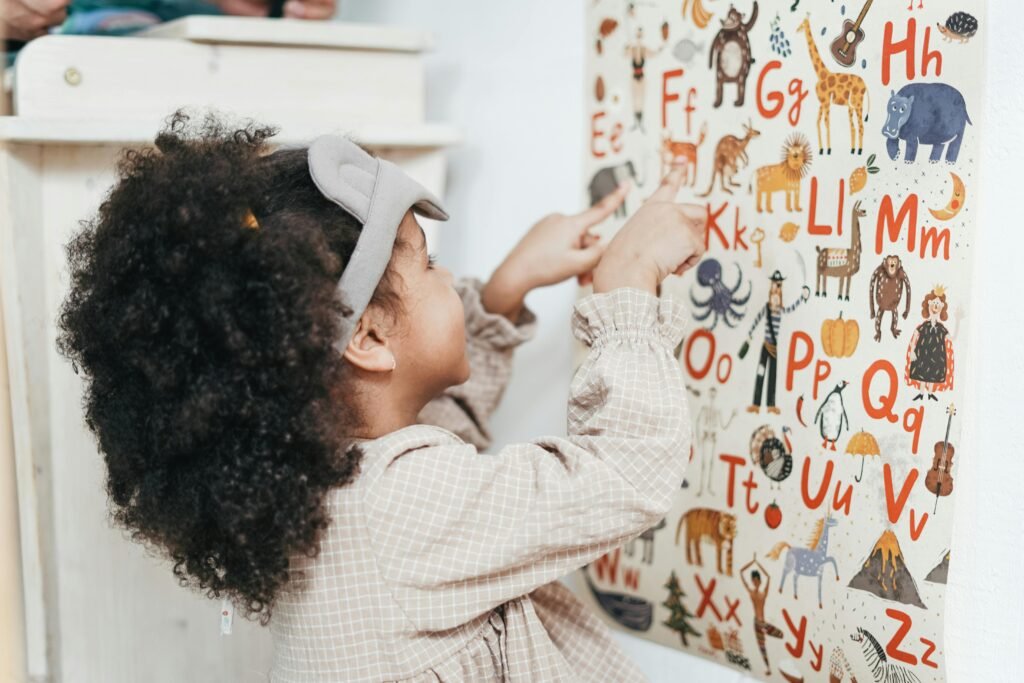
Concerned your pre-reader may struggle when reading instruction begins? Have a child currently struggling to read? This article (part 1 of our Reading Readiness series) is for you!
Table of Contents
- What is the Letterbox?
- How to Know if Your Child Struggles with Letter Distinction or Identification
- Reading Readiness Activities to Develop the Letterbox
- Conclusion
There are several areas in the brain involved in the reading process. In order for reading to go smoothly, each of these areas needs to be fully developed. Whether you are concerned that your young child may struggle with reading when they reach school age or if your elementary child is already struggling, this article series will give you knowledge and activities you can use to help strengthen the specific areas of the brain required for reading!
The area of the brain we will focus on in this article is often referred to as the brain’s “letterbox” (Dehaene, 2010, pp. 55-76). This article is part of a series of articles that will each address a specific brain system. The links to the rest of these articles are below!
- Reading Readiness: Developing Your Child’s Sound Awareness Before They Can Read
- Reading Readiness: Developing Your Child’s Language Comprehension Before They Can Read
For more information on how the areas and systems of the brain coordinate to help us read, see this article or consider purchasing my course, “A Parent’s Advantage for Struggling Readers.”
What is the Letterbox?
The Letterbox is the brain’s special storage spot for the letters of English (or any language)! It is housed in the visual part of our brain called the occipital lobe. The occipital lobe learns to separate everything we see into categories. Numbers, facial expressions, letters, etc., all get their special spot in the occipital lobe. The letterbox in most children develops by looking at books and by having books be read aloud. The brain realizes, “Oh, these squiggles on the page have their own special meaning, and they are different from anything else we look at. We should probably give them their own special spot!”
When formal letter instruction begins, the letterbox becomes even more specialized. It draws attention to letters’ unique shapes, noticing lines, slopes and curves. It stores the shapes of each letter into long term memory and connects it to a name. It isolates distinct letters in a word, like processing “cat” as three individual letters rather than as a whole. Then, it does something truly amazing: it realizes that “A” and “a” mean the same thing even though they look nothing alike, and so do “P” and “P” even though they look slightly different (Seidenberg, 2017, pp. 107-109). This process of specialization takes longer for some children than others. The jury (science) is still out on exactly why that’s the case.
How to Know if Your Child Struggles with Letter Distinction or Identification
Letter distinction refers to distinguishing letters from other visual stimuli in our environment, and recognizing that there are individual letters within a word. Letter identification is also the ability to say the names of letters.
If your child is already in elementary school, the first step in knowing whether your child needs to strengthen their letterbox is to figure out if letter distinction or identification is one of the issues keeping your child from being a successful reader. Remember to always consider if a lack of quality instruction in the classroom or not having been given enough time to learn are the reasons your child may be struggling, rather than immediately assuming they have a learning disability. For more on how to determine if the issue is poor instruction or an actual learning disability, read this article.
Signs of Struggle
If you child has been through pre-school (with letter instruction) or kindergarten, here are some signs that they struggle with letter distinction or identification:
- Your child cannot count the number of letters in a regularly printed written word, but they can count other objects
- Your child gets letters and numbers confused
- Your child cannot remember the names of letters
- Your child confuses visually similar letters like “b”, “p” and “q,” or “i” and “l”
- Your child often says the sound a letter makes when being asked to say its name
- Your child has not connected uppercase letters to their corresponding lowercase letter
If your child is not in school yet, you do not need to be as concerned about the signs above. They may just not be developmentally ready to meet these standards yet (consult with your pediatrician to confirm). You can still do these activities preemptively to ensure they have a strong letterbox before they are expected to read words. It is never too early to start these types of pre-reading activities!
This article is the first in our three-part Reading Readiness series. All articles in this series and their content are free. For parents who want more specifics, we offer a comprehensive guide that pulls together essential knowledge from this series and other articles to review and deepen the knowledge gained here.
The guide boasts over 30 printable pages of assessments, rubrics, planners, and activities to help you implement what you have learned and track your child’s progress. This guide features:
- Informed, science-backed conclusions about how our brains learn to read
- Complex topics explained in clear and simple language for overwhelmed parents
- Practical suggestions for how and when to talk to your child’s teacher
- Simple activities that can be incorporated into everyday life for busy families
- Activities appropriate for children ages 2-7
- Activity and assessment accommodations for children’s various learning styles, interests and strengths (music, movement, art, acting, etc.)
We believe this guide is VERY comprehensive and will be invaluable to you. We also want it to be accessible and to thank you for reading our article series. So…
Click the image to the left to grab your guide and use the discount code ARTICLE to grab the comprehensive guide for only $15!
Or read to the end of the article for an EVEN DEEPER DISCOUNT!
Reading Readiness Activities to Develop the Letterbox
The following skills and their subsequent activities are presented from easiest to most challenging. Use your best judgement as a parent to determine when to move to the next activity! They do not need to perform an activity with 100% accuracy before moving to or adding on the next one. The pacing totally depends on your child. For example, you may spend several weeks, months, or just a few days on an activity, and that’s okay! If you choose to make your way through all of these activities, expect that the whole progression could take a year or more.
Click on the graphic above to grab “A Parent’s Comprehensive Guide to Reading Readiness” to supplement the following activities with print-ready activity pages, rubrics and trackers! Use the discount code ARTICLE to grab the guide for only $15!
Distinguish letters and pictures
The most explicit way you can teach your child the basics of letter knowledge is to begin by pointing out what letters are and what they look like. At the most basic level, children need to clarify that letters and words have a very specific and special meaning compared to anything else they look at, such as pictures or shapes. The concept that letters are squiggles that represent the sounds we make with our mouth is a concept that children who struggle with letter distinction need explicitly pointed out. The recommended age for practicing and assessing this skill is 2-3 years old.
- When reading books together, point out pictures and words. Name which is which and explain that you know what to say on each page because of these letters. We don’t just make up what we want to say in the story based on what we see. The letters tell us what to say when we read.
- Find items around the house, like cereal boxes or other containers with labels. Point out the pictures and the words. Ask your child to describe the items, colors, or textures they see in the pictures. Then you can point to the words and explain that the words can tell us even more about the picture. Read the words to them as you point to each one.
Distinguish letters and numbers
A slightly more difficult distinction is between letters and numbers, since they are both squiggles that represent abstract concepts. The easiest way to do this is simply to practice slowly and to not expect your child to memorize the letter sounds or number values at this point. The recommended age for practicing and assessing this skill is 3-4 years old.
- Find letter or number puzzles. As children match the pieces, simply say the sound of the letter and a word that starts with the sound (i.e. “that letter spells /a/ like “aaaaapple”) or count to the value of the number on your fingers. Do this every single time they do the puzzle, but do not expect them to do this on their own. The goal is simply for them to recognize that “A B C” means sounds and “1 2 3” means counting on my fingers.
- Keep letter exposure and number exposure separate at the beginning. If you are wanting to do alphabet or counting activities, present them at different times so that your child begins to group each set of squiggles separately.
Separate letters within words
After you have spent several months working with your child to identify what letters and words look like, you can then move to helping them distinguish letters within words. At this point you are not having them memorize the letter names or the spellings of words. The purpose of these activities is to help them realize that words are made up of individual letters, and that they are not all one letter shape. We are drawing attention to the tiny spaces between letters within a word. The recommended age for practicing and assessing this skill is 3-4 years old.
- On a whiteboard or some blank laminated paper, write a two or three-letter word. Show your child how you can draw a circle around each individual letter and then count the letters. After modeling a couple times, write a word on the board and see if your child can circle the letters, then count them together. And repeat with more words! As your child masters this activity, move to longer words.
- Print two or three-letter words on paper in a large and plain font. Cut the words apart so you can present them each separately. Show your child the word and count the letters. Then cut between each letter to separate them. After modeling with a couple of words, present a new word, count the letters with your child and have them do the cutting. Check to make sure the number of pieces they have is the same as the number of letters you counted at the beginning! And repeat with more words! (If your child is struggling with this activity, draw squares around each letter as you count them before you cut.) As your child masters this activity, see if they can do it more independently and move to longer words.
Build letter name knowledge
Letter knowledge refers to everything we know about a letter: its shape, its name, its sound, its uppercase/lowercase versions, where it falls in the alphabet, what other letters it is often next to in a word, etc. If you are a fluent reader, you have deep letter knowledge, although much of it may be subconscious! When beginning letter instruction, the most foundational characteristics to begin with are a letter’s shape, and name. (Sounds are a close second, but we will save that for the next article.) Letter sounds can be taught at this time but your child isn’t expected to master them yet. The recommended age for practicing and assessing letter knowledge is 4-5 years old.
- Start with the letters in your child’s name. Present their whole name by writing it or printing it somewhere in large and plain font. Tell them you will focus on one letter at a time and indicate that letter either by underlining it, circling it or writing it in a different color. Focus on one letter for 3-5 days at a time. To build letter shape knowledge, your child can make it out of playdough, trace it with chalk or in sand, color it with crayons, or glue scraps of tissue paper along its lines. These should be fine motor, hands-on activities. Choose activities your child is capable of and will enjoy. (Check out our Pinterest page for more letter knowledge activity ideas!). I would recommend only one or two activities per day depending on the age of your child. Throughout this process, you should repeat the name of the letter over and over. Do this with all the letters in their name and circle back to review any as needed. Before you begin each day, say the names of all the letters taught up until that point!
- You will follow the same process as you did in the previous activity when you present all the letters in the alphabet. Display the entire alphabet in alphabetical order in large and plain font, while indicating which letter you will focus on for the next 3-5 days. Use all types of fine-motor activities to emphasize the letter’s shape as you repeat its name. Depending on their age, you can expect your child to begin writing the letter on their own using a crayon or pencil with or without copying. As you work through the alphabet, review which letters are the ones found in their name. Before you begin each day, review previously taught letters by singing or saying the letters they have learned up until that point! If needed, circle back every 3–5 letters to review a few letters for a day or two.
- Follow the same process again, but now present the letters in order of how frequently they appear in the English language. (See the free printable below for the list of letters in frequency order!) Before you begin each day, sing the entire alphabet song to review all the letter names but then remove the alphabet visual and present only the focus letter. On this round of practice, it is now appropriate to present the sound of the letter along with its name. Say the name and sound of the letter multiple times during the activity. Continue using various fine-motor activities to focus on the letter shape but slowly switch your emphasis to expecting them to produce the letter shape on their own using a crayon or pencil without copying it. If needed, circle back every 3–5 letters to review a few letters for a day or two.
Conclusion
Don’t forget – all brains are malleable and are capable of being changed. Your child’s brain is not stuck in a never-ending struggle of learning to read. These types of activities can help create foundational change at the brain level so they don’t pick up fake-it-till-you-make-it habits or begin to view themselves as a kid who can’t read. To learn more about how to change your child’s brain and better equip it for reading, check out the rest of the articles in this series, consider purchasing our course “A Parent’s Advantage for Struggling Readers,” or book an affordable consultation for some tailored next steps!
Here’s to setting your pre-reader up for success!